IoT / Embedded Security
Adaptive Encryption for Resource-Constrained IoT Devices
An ESP32 prototype comparing SPECK, SIMON, ASCON and AES under constrained conditions, with encrypted telemetry sent over MQTT/TLS.
Project access
Open live demo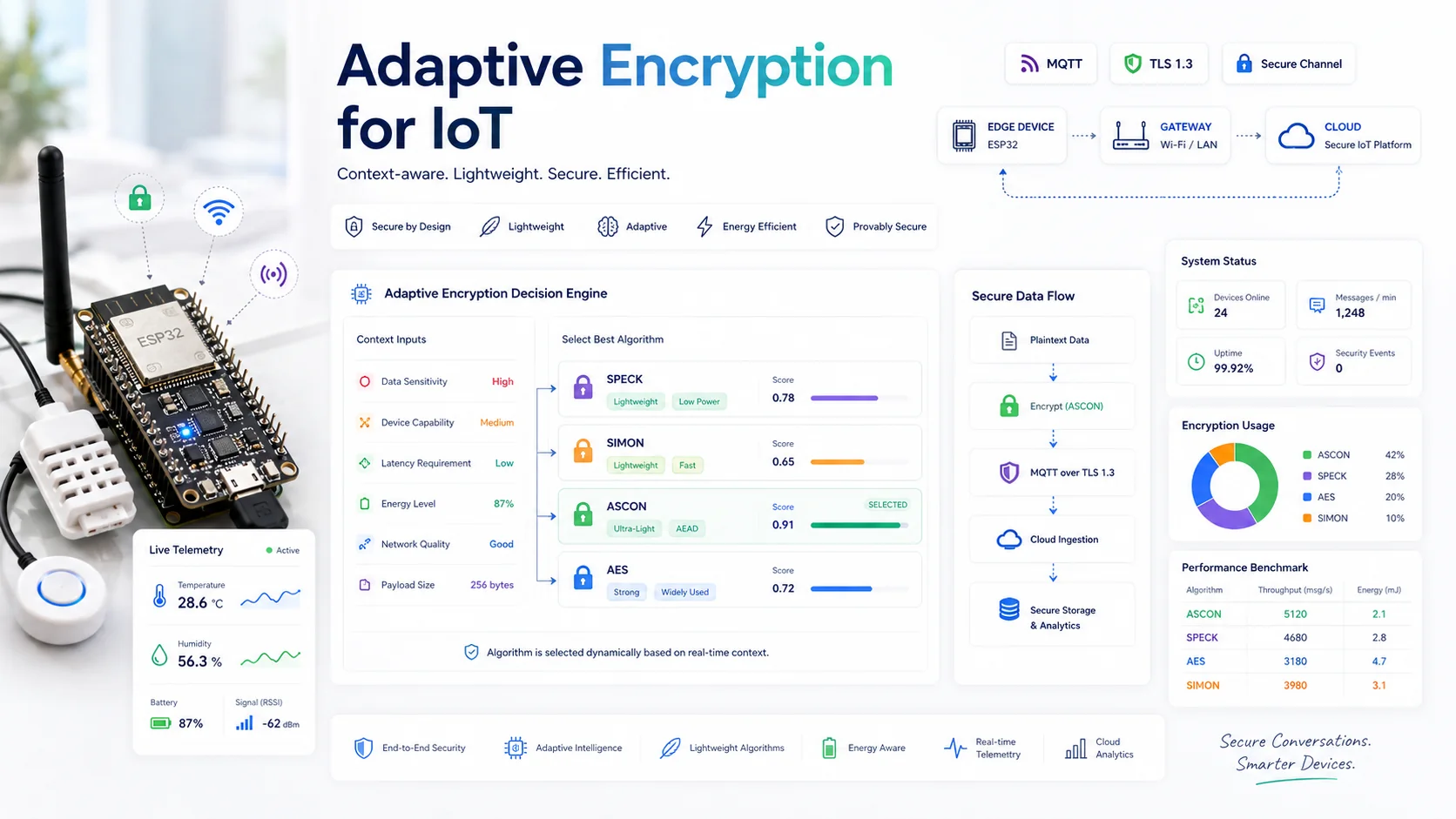
Adaptive security flow
About the project
Testing encryption choices on an ESP32
This project tests whether one cryptographic algorithm is the best choice for every operating condition on a constrained IoT device. I compared SPECK, SIMON, ASCON and an AES software baseline on ESP32.
I worked on the research, firmware, experiment setup, measurement and analysis. The device sends encrypted telemetry over MQTT over TLS, and the results are limited to the hardware and dataset sizes used in this project.
What I tested
01
Adaptive selection
Uses measured profiles to choose among the tested algorithms based on the current device state.
ESP32 firmware + selection rules
02
Encrypted telemetry
Sends encrypted sensor data over MQTT/TLS.
MQTT/TLS
03
Measured experiments
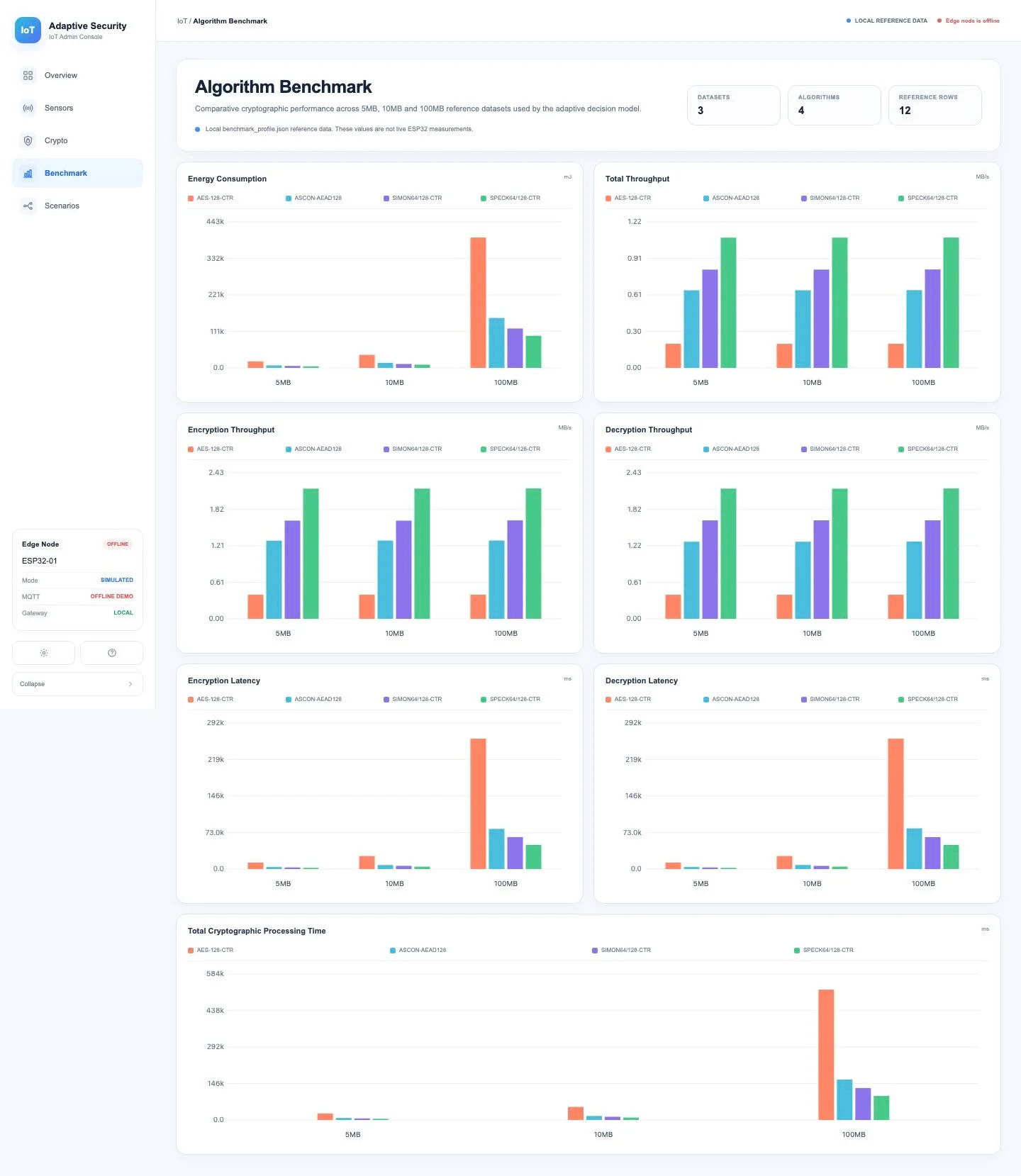
Compares execution time, throughput and energy on 5 MB, 10 MB and 100 MB test sets.
Benchmarking + measurement
What I measured



- Datasets
- 5 / 10 / 100 MB
- Algorithms
- SPECK / SIMON / ASCON / AES
- Transport
- MQTT over TLS
- Hardware
- ESP32
What the experiments showed
What worked
- Across the project experiments, SPECK was about 5.39× faster than the AES software baseline.
- Measured energy for SPECK was approximately 75% lower than the AES software baseline across the tested dataset sizes.
What I learned
- These numbers belong to this project setup; I do not treat them as universal cryptographic claims.
- An adaptive strategy only makes sense when the state rules and trade-offs are explicit and measurable.